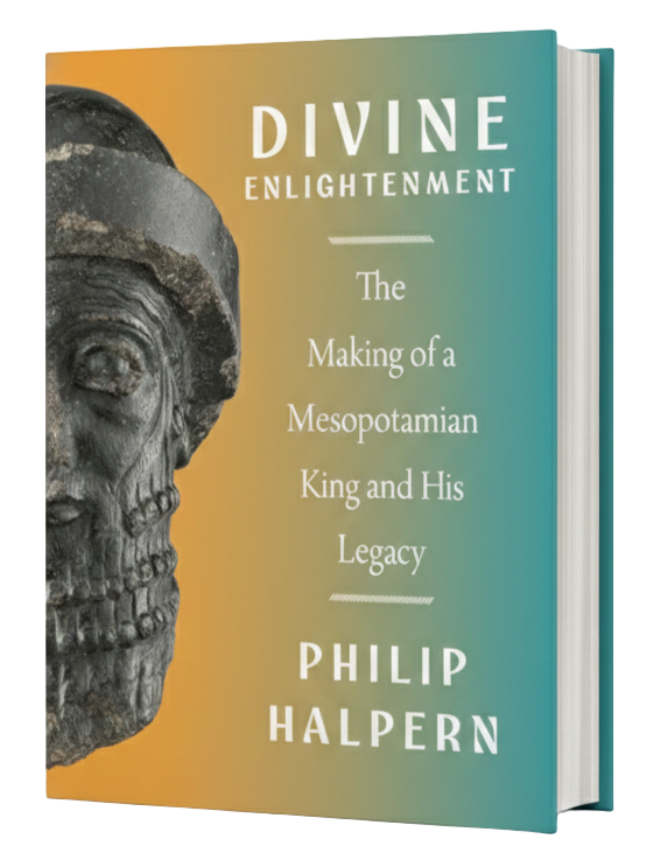
Divine Enlightenment:
The Making of a Mesopotamian King and His Legacy
The Code of Ḫammurabi—best known for the phrase “an eye for an eye”—stands as one of the most enduring legal monuments of the ancient world. In Divine Enlightenment, Philip Halpern explores how King Ḫammurabi of Babylon may have arrived at the moral and legal insights embodied in the famous stele.
“Ḫammurabi, the pious prince, who venerates the gods, to make justice prevail in the land, to abolish the wicked and the evil, to prevent the strong from oppressing the weak, to rise like the sun-god Šamaš over all humankind, to illuminate the land.”
— From the Prologue of the Code of Ḫammurabi
What Leading Mesopotamian Scholars are Saying
“I love the idea of making the god speak.”
“Halpern’s coming of age story, grounded in deep scholarly research and accessible to all audiences, vividly imagines ancient Babylonia through the eyes of a young prince destined to become one of history’s most famous lawgivers. As he journeys through his kingdom, Hammurabi observes and listens to the stories of his subjects, learning what it truly means to rule with wisdom and justice.”
“It has been my personal aim to have the Ancient Mesopotamian texts we study come to life, not just by translating and interpreting them but by trying to distill the thoughts and motivations of the ones who wrote them. Halpern’s book goes further into the realm of fiction but that can only make it more vivid and pleasurable for a larger audience. The interaction of men and gods is lively and entertaining and enlightens many a cultural/historical point. At the same time the bibliography shows that his work is based on solid academic work.”